
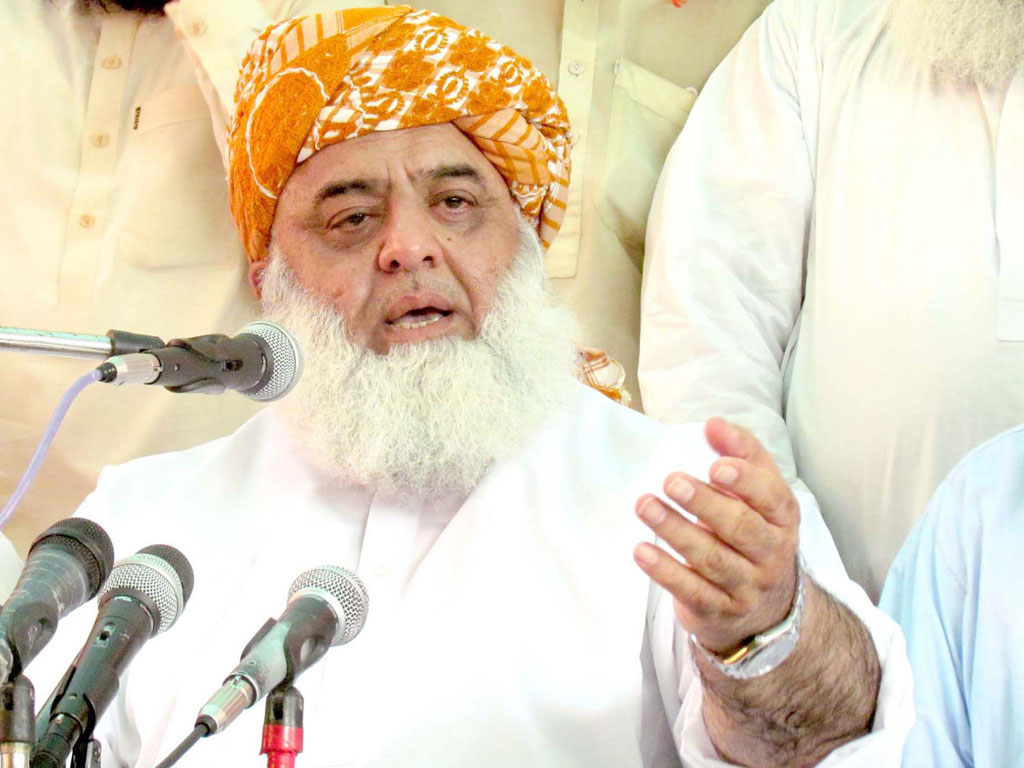
Historically, 'Islamabad lockdown' threats have been a weapon of choice with groups and parties opposed to the policies and plans of sitting governments. Did these ever work? Results were not very encouraging, though. But, invariably, such threats played havoc with the life of man on the street. One such threat has been now made by JUI (F) chief Maulana Fazlur Rehman. Addressing a presser in Islamabad on Sunday, he said his party has decided to undertake a 'decisive' long march on Islamabad aimed at ousting the present "fake government". According to him, "should government try disrupting the march" - an oblique reference to interior minister Ijaz Shah's comment a day before that people will intercept the maulana - "a huge sea of people will sweep small trouble makers like straws". Asked what would be the venue of the protest march, Maulana Fazl said it would be all over Islamabad. "No street will be empty". In past, all such marches on the nation's capital have been partial, though they too paralyzed day-to-day life of the residents. Add to this, his take that religious elements too would join the march, and one is reminded of the two sit-ins at Faizabad Interchange of which not the government but ordinary people were the main victims. Even when the Imran-Qadri sit-ins opposite parliament and Blue Area were confined to a part of the city these too proved to be back-breaking for the capital's residents.
Should Maulana Fazlur Rehman's threat actualize into complete shutdown of Islamabad, it would be nothing but an apocalypse for the capital's residents. And, the PTI government may still survive - those on the same page with it may not like to change horses midstream. Pakistan's stand against the Indian aggression in Occupied Kashmir doesn't brook any sign or move suggesting divergence from the nation's united stand against India. However, an incisive look into the plan to march on the capital exposes its hollowness - just as it did by flopping the opposition's no-confidence motion against Senate chairman Sanjrani. In fact, the maulana too is sceptical about others in the opposition standing by his side for the march on the capital. In days to come, he would be meeting other members of the Rahbar committee and heads of opposition parties. Quite curiously, he has described his plan as "Azadi March" as one would think it would be in support of Kashmiris, but he says it is "to get rid of the incompetent and illegitimate government" of Imran Khan.
Being generational beneficiary of real politik, Maulana Fazlur Rehman should not have raised the ante of marching on Islamabad, especially now when the country is beset with existential challenge. For whatever reasons - some of which are certainly collateral of religious extremism pervading many parts of the Islamic world - the frustrating reality remains that the kind of international sympathy and support the Kashmiris need now is not there. Even some of the members of OIC have acted in a way that puts them in the category of Modi's admirers. Millions in Pakistan may be fed up with the present dispensation, and may like to get rid of it. But there is the compelling cause to put up unmistakable signals that Pakistan is a united nation. One doesn't have any doubt about the JUI (F)'s absolute commitment to freedom of Kashmir. But what rankles one's mind is the feared fallout of maulana's plan to march on the capital to topple the government. Accepted, in functional democracies there is nothing wrong to plan the ouster of a sitting government. But that should be the force of vote in parliament, especially in the light of our political history which tells us that such marches and movements quite often tolled the bell on the very process of democratic governance. The JUI (F) chief may like to rethink his plan and tone down his threat of storming the nation's capital in view of the situation obtaining on country's eastern borders.